Modern vehicles depend on complex electronic systems to control everything from engine performance and emissions to safety systems and comfort features. As a result, a capable OBD2 scanner paired with a reliable OBD2 app is no longer optional — it’s essential.
Two widely known options dominate this space: Carista and Carly. Both promise diagnostics, coding, and maintenance tools. However, when evaluated against real-world use cases — depth of access, speed, compatibility, and cost control — Carista consistently delivers broader, more practical value.
What problems are OBD2 scanner users actually trying to solve?
Before comparing tools, it’s critical to define the problems users are trying to fix.
Warning lights and fault codes
When dashboard lights appear — check engine, ABS, airbag, emissions — drivers need:
-
Accurate fault code reading
-
Clear indication of severity
-
Confidence whether the issue is minor or urgent
Basic scanners read only generic engine codes, leaving critical systems unchecked.
Diagnostics beyond the engine
Modern cars contain dozens of control units. True diagnostics require access to:
-
Engine and transmission
-
Body and comfort modules
- Safety and emissions systems
Without manufacturer-level access, diagnostics remain incomplete.
DIY maintenance and service procedures
Routine maintenance now requires electronic access for:
-
Service interval resets
-
Electronic parking brake service mode
- Battery registration
-
Emissions and diesel system checks
Coding and personalization
Coding is a primary purchase driver. Users expect to:
-
Enable or disable features
-
Adjust parameters
- Customize lighting, locking, and comfort behavior
This demands stable Bluetooth communication and deep system access.
Used car checks
A proper used car check requires:
-
Scanning all modules
-
Detecting hidden or historical faults
-
Assessing overall vehicle health
Generic scanners frequently overlook these defects.
The buying criteria that actually matter
Strip away branding, and the choice comes down to five factors:
-
Vehicle and system compatibility
- Depth of diagnostic access
- Speed and Bluetooth stability
- Hardware openness
- Subscription flexibility and lifetime cost
Side-by-side comparison: Carista EVO vs Carly

Key differentiator #1: Manufacturer-level access and SFD unlocking
Why SFD matters
At Carista, we see SFD (Schutz Fahrzeug Diagnose) as a key change on newer Volkswagen Group vehicles. SFD is a diagnostic security layer that can restrict access — coding, adaptations, and basic settings — unless the tool is authorized by the vehicle.
On SFD-protected cars, reading fault codes is usually allowed, but coding and service actions are limited or blocked without proper SFD authorization.
Learn more: https://carista.com/blogs/news/how-to-unlock-sfd-settings-a-comprehensive-guide
Carista supports official SFD unlocking when using the Carista App with the Carista EVO Scanner. As an official Volkswagen Group partner, we provide in-app SFD authorization, including support for newer SFD versions introduced on recent model years.
Details: https://carista.com/blogs/news/sfd-unlock-vw-audi-seat-skoda-carista
Result: authorized access to SFD-protected control units and the ability to perform coding and service procedures that are otherwise unavailable.
Carly comparison
Carly’s support documentation includes extensive troubleshooting and module-availability guidance, but does not publicly document an “official SFD unlock” capability comparable to Carista’s described SFD unlock flow. (Carly Support Center)
Bottom line: For VAG owners on SFD vehicles, Carista’s explicitly documented SFD unlocking support is a material, defensible differentiator.
Key differentiator #2: Speed, Bluetooth stability, and real usability
The real-world issue
Users buying consumer OBD dongles care about one thing that decides whether coding/service will succeed: stable connectivity during operations.
Carly’s own documentation shows connection problems are common enough to warrant dedicated troubleshooting articles for their scanners (current and previous generations).
Carista EVO’s hardware positioning
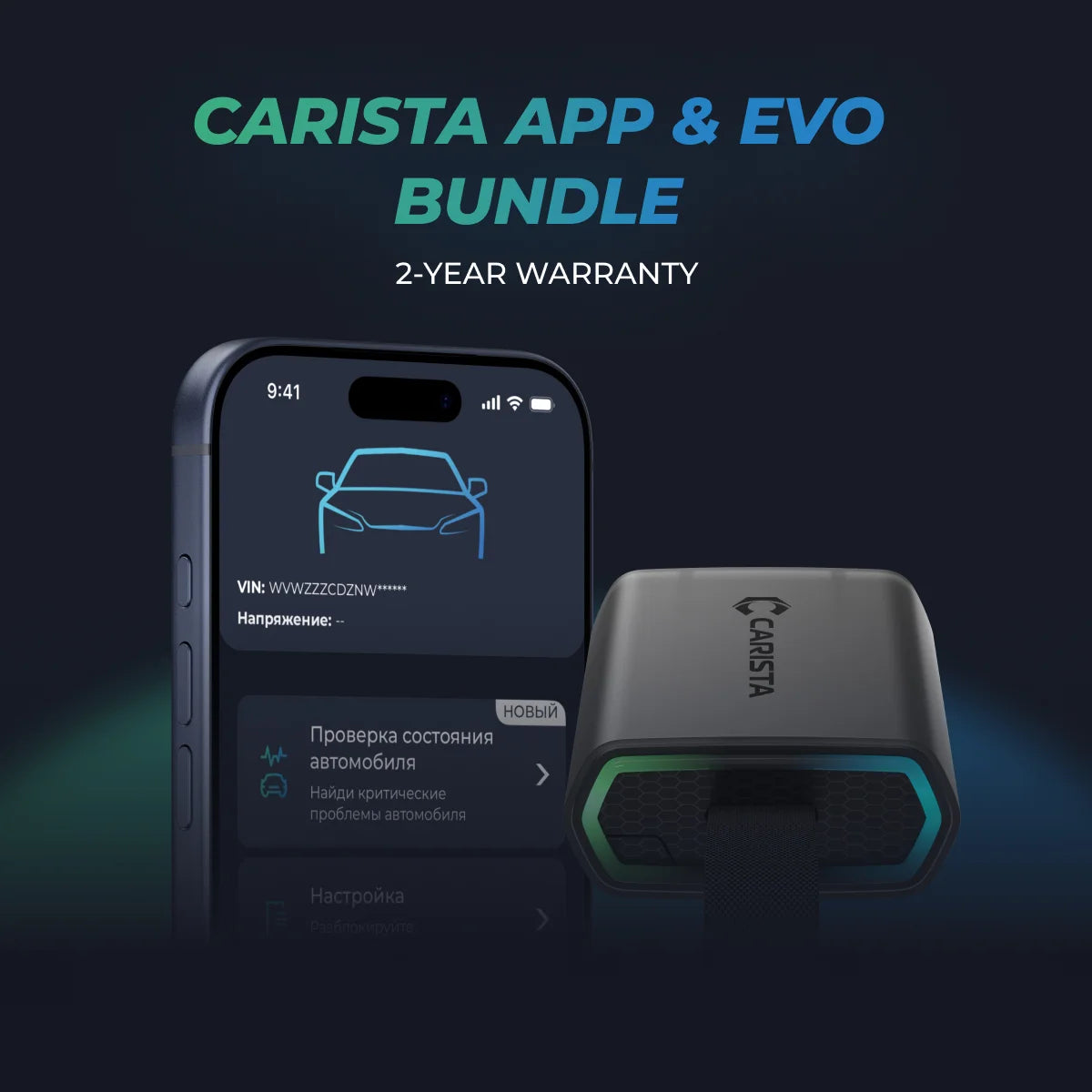
Carista positions EVO as premium hardware with fast and stable connectivity:
- 3x times faster- reduces delays when scanning, coding, or performing service procedures
- Bluetooth 5.1 connectivity — ensures faster pairing, stronger signal, and more stable communication during critical operations
- 32-bit ARM processor — significantly improves processing speed compared to basic 8-bit scanners
- Battery-saver sleep mode — prevents unnecessary battery drain when the device is plugged in
Practical framing
Speed and stability are not “nice-to-haves.” If a session drops during a diagnostics/coding action, the user experience ranges from “failed change” to “time-consuming recovery.” EVO’s positioning is that it reduces that risk by design.

Key differentiator #3: Protocol coverage and advanced diagnostics
Why protocol support matters
Not all brands/modules use the same network/protocol expectations. Without the right protocol support, diagnostics can become partial (e.g., body modules inaccessible).
Carista EVO’s documented protocol coverage
Carista explicitly documents protocol differences between Carista OBD Reader and Carista EVO Scanner:
- Carista states EVO supports HS-CAN, MS-CAN, SW-CAN (GMLAN), and K-Line, and explains which ecosystems those protocols are commonly found in “Carista EVO or Carista OBD?”
- Carista’s EVO pricing page also highlights MS-CAN support and SFD unlocking as EVO enhancements.
User benefit: EVO is better suited for multi-brand households and for owners who expect to access more than “generic OBD2” powertrain data.
Key differentiator #4: Open device vs. locked ecosystem
Carista EVO is positioned as an “open” Scanner
Carista documents that its scanners can be used beyond the Carista App:
- Compatible with: All ELM327 apps on Android; partner apps on iOS.” “Which devices and apps work with Carista?”
- Carista also publishes a partner-app overview emphasizing multi-app compatibility. Partner diagnostic apps
Practical result: user hardware keeps residual value if they switch apps or add a second app for live data/dashboards, etc.
Carly’s ecosystem is effectively app-tied
Carly’s support materials center on the Carly app/scanner pairing and troubleshooting that pairing. Example: the Universal Scanner troubleshooting page is Carly-app specific. Carly Universal Scanner troubleshooting
Key differentiator #5: Subscription flexibility and cost control
Carista’s subscription options
Carista lists 1-month and 12-month plans:
- Carista: 1-month
- Carista: 12-months
- Help Center confirms plan structure (1-month billed monthly, 12-month billed annually). “What kinds of Pro subscription plans are available?”
Defensible positioning: Many users code once or do periodic diagnostics; monthly access reduces “forced annual commitment” friction for intermittent use.
Carly pricing model
Carly publishes plan/pricing information emphasizing subscription access.
- Carly: Plans/Prices
- Carly’s own explainer article references an annual subscription starting price point (noting it changes by region/promotions). Carly blog: “How much does Carly cost?”
Which should you choose?
- Newer VW-Group vehicle owner with SFD: Carista EVO, because SFD unlock is explicitly documented by Carista as an official VW Group partner.(Carista SFD)
- DIY maintenance enthusiast / used-car buyer: Carista EVO, based on full-ECU scan + service tools + month option.
- Multi-vehicle household / multi-brand: Carista EVO, because protocol coverage (HS-CAN/MS-CAN/SW-CAN/K-Line) is explicitly documented as an EVO advantage. (Carista EVO vs OBD)
- Users who want an app-only experience Carly can be adequate, but connection reliability and feature availability are more likely to be constrained by ecosystem and vehicle security layers. (Carly troubleshooting).
Conclusion: Why Carista EVO is a better OBD2 choice
Measured against real-world requirements — diagnostics depth, access, speed, compatibility, and cost — Carista EVO offers the stronger overall package:
-
Manufacturer-level diagnostics
-
Reliable coding and service functions
-
Broad protocol and model support
-
Open hardware design
-
Flexible subscription options
-
Superior long-term value
- Official VW/Toyota partner
For drivers who want control over their vehicle’s health, accurate used car checks, and a future-proof OBD2 solution, Carista EVO is the more capable and economically rational choice compared to Carly.
FAQs: Carista or Carly?
Is Carista better than Carly for beginners?
Yes. Carista is generally more user-friendly, with clearer diagnostics and simpler workflows, making it suitable for both beginners and advanced users.
Which OBD2 tool has better connection stability?
Carista EVO is positioned as having faster and more stable Bluetooth connectivity, which is critical during coding and service procedures.
Does Carly support SFD unlocking?
Carly does not publicly document an official SFD unlock solution comparable to Carista’s supported in-app authorization for VW Group vehicles.
Can both tools read and clear fault codes?
Yes. Both Carista and Carly can read and clear fault codes, but Carista provides deeper multi-system diagnostics beyond basic engine data.
Which is better for multi-car households?
Carista is better suited due to its broader protocol support and compatibility across multiple vehicle brands.
Do Carista and Carly require subscriptions?
Both use subscription models, but Carista offers more flexibility with monthly and annual plans, while Carly leans toward annual subscriptions.
*Disclaimer: The information provided in this article is intended for educational and informational purposes only and should not be considered as professional advice. While we strive to provide accurate and up-to-date content regarding OBD2 tools, diagnostics, and related automotive issues, the specifics of each vehicle may vary.
*Always consult your vehicle’s manufacturer guidelines and consider seeking professional assistance when dealing with complex or critical diagnostic issues.